Showing posts with label South America. Show all posts

Monday, March 8, 2010

Uruguay

The history of Uruguay began with the 500 day Argentina-Brazil War in the 1820's for control of their border region. The war ended in a stalemate and a compromise. The border region that had been fought over was transformed, thanks to the coercion of the British, into the independent state of Uruguay. Despite being the second smallest nation on the continent, Uruguay is one of the most affluent countries in South America. Much like Argentina, Uruguay remains very old world in it's culture. The overwhelming majority of Uruguayans are descendants of past waves of European immigrants. Much like it's population, the food of Uruguay is also an offspring of European culture.

To be honest, we did not find many differences between the foods of Uruguay and Argentina. Both countries claim many of the same foods as their national dishes. Fortunately, there were a lot of foods I wished I had the chance to make when we did Argentina. Uruguay provided the perfect opportunity to cook what we didn't get the chance to make last time around.

Burnt Carrot Salad

Uruguay isn't well known for any vegetable dishes, so we just made this one up to compliment all the roasted food we were eating. I find roasted carrots to have a sweet and savory flavor that goes great with any meaty meal.


1 head red leaf lettuce washed and chopped
2 pounds carrots peeled and cut into fairly thick 2 inc spears
4 tbsp olive oil
1 red onion thinly sliced
1/2 cup shelled pumpkin seeds (I have no idea how to shell these things effectively with my hands, but many latino markets sell them preshelled)
1 bell pepper seeded and sliced
1/4 cup dried cranberries
1/2 cup olive oil
1/4 cup sherry vinegar (or red wine vinegar)
Salt and pepper to taste

1. Fire up the broiler or the grill and rub the chopped carrots with five tablespoons of olive oil and cook until they are nicely browned and soft. Set aside to cool.
2. Shortly before serving combine all the ingredients in a large bowl and taste for seasoning. Feel free to add more olive oil or vinegar.

Polenta Gratin
This recipe was probably made popular by the many Italians who immigrated to Uruguay. It's absurdly simple to make, and involves very few ingredients; making it a great cheap way to feed a large crowd guests.

2 cups coarsely cut corn meal
6 cups water
1 tbsp salt
Butter
1.5 cups cotija or other crumbly cheese

1. Combine corn meal, water, and salt in a saucepan and bring to a simmer.
2. Reduce the heat to low, cover, and cook for 30 minutes.
3. Grease a fairly shallow casserole dish with the butter and add the corn mush to the pan. Allow 15 minutes to set in the dish.
4. Top the mush with the cheese and bake under a broiler until the cheese browns about ten minutes.
5. Serve.

Bacon Empanadas

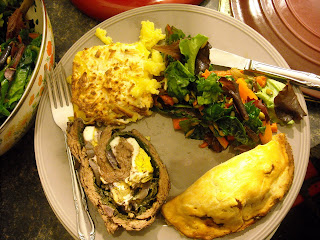
No picture for these this time, but they looked exactly like the empanadas we made for Argentina. The filling in these empanadas make them quite different from what we served for that meal. Although bacon and raisins might sound like a horrible mistake to some, let me assure you that bacon is a sweet meat that tastes great when paired with other sweet things.

For the dough

4 cups all purpose flour
1 egg
1 cup lard chilled
1 tsp salt
1 beaten egg for coating

For the filling combine the following:

1/2 pound bacon thinly sliced and roughly chopped and cooked in a skillet until crisp
3 medium onions thinly sliced and and sautéed until golden brown
4 cloves garlic finely chopped
1/2 cup golden raisins soaked 30 minutes
Flesh of two avocados roughly chopped
1 cup crumbly cheese such as cotija or feta
3 tbsp capers

1. Combine all the dough ingredients but the beaten egg in a food processor and process until a smooth ball forms. If it remains a goopy mess add more flour until a ball is rendered.
2. On a lightly floured surface kneed the ball of dough until it is no longer sticky.
3. Set aside for a half hour in a lightly oiled bowl covered.
4. Cut the dough into golf ball sized spheres and roll each sphere into flat circle.
5. Fill each circle with about 2 tablespoons of the filling.
6. Brush the edges of the circle with the beaten egg mixture and seal them into half moon shapes pressing the edges to make sure they are closed.
7. Brush the tops of the pastry with the egg mixture and bake in a 400 degree oven for twenty minutes. Serve.

Matambre: Roast of Stuffed Skirt Steak Braised in Red Wine

For me, this was the real star of the meal. It's difficult finding good quality beef around my neighborhood for a reasonable price, but fortunately skirt steak sells fairly cheaply here because of the large Latino population. Unfortunately, the meat is cheap for a reason and tends to be very tough. The slow braising in this recipe breaks that toughness down and makes the cheap beef a pleasure to eat, and a great way to feed a group of friends a roast while staying on a tight budget. Also, the final product looks lovely on a plate.

4 lbs skirt steak trimmed of excess fat
2 red onions thinly sliced
5 cloves garlic finely chopped
1/2 cup green olives stoned and chopped
4 carrots cut into small spears
1.5 cups cotija or other crumbly cheese
4 hard boiled eggs cut into rings
5 oz fresh spinach washed
Bottle of red (dry)

1. Divide the skirt steak into two equal sized 2lb portions. With a meat mallet pound the skirt steak until it is about 1/2 inch thick taking care not to shred the meat. I recommend wearing an apron as you do this because it can get messy. I for some reason did it shirtless like a caveman.
2. Salt and pepper both sides of the steak and layer all the filling ingredients over the surface.
3. Roll both flattened steaks as tightly as you can taking care to keep the ingredients from spilling outside of the meat.
4. Tie the rolls up well with butcher's twine and place them side by side in a large cast iron pot. Fill the pot with the red wine and bake in the oven at 325 for 2 hours covered. Flipping the roasts once after one hour of cooking.
5. Remove the roasts from the pot, cut and remove the twine, carve into individual rounds and serve topped with juices from the pot.

In Conclusion

I was very pleased with this meal. Not only was it easy to make, but the food looked and tasted wonderful. The meal was made even better by the surprise visit of two of our good friends from Cleveland who came into town that night. Much like our other meals, everybody had a great time and drank way too much over the course of the evening! Up next is Rwanda! Salud!

Monday, February 1, 2010

Guyana

Guyana is a country that many people mistakenly think is located in Africa. If you happen to be one of those people, let me assure you it is not an African country. It just so happens that it's geographic location is at the northern end of South America. Culturally speaking, however, Guyana is a Caribbean nation composed of a wonderful mess of world cultures that has resulted from a very complicated colonial past involving multiple European powers; the most recent being the British Empire. Today Guyana's population is split between East Indians and Black Africans with significant native Arawak, White European, and East Asian minorities. The food is a perfect fusion of these cultures. Strong flavors and lots of spices are the dominant characteristics of the cuisine.

Today Guyana is not well known for very much. That shouldn't be too surprising. After all, their national population is smaller than the total population of Indianapolis. But I did manage to uncover a few fascinating tidbits from Wikipedia. Apparently British actor, Michael Caine, has been happily married for nearly forty years to Shakira Caine: the former runner up for Miss Guyana 1967. She continues to be a foxy old lady. And Eddy Grant (better known as that guy who did the song 'Electric Avenue' in 1983) is a native of Guyana although he was raised in England. We played a whole album of his during the meal.

Fortunately for us, Northwestern University (the place I work at) has an obscure Guyanese cookbook in their library that I have used off and on for the past few years. Also, the Guyanese take great pride in their food and have peppered the internet with many of their favorite recipes. The most thorough listing I came across was at this web forum. Amy and I were pleasantly shocked to find there was such a wealth of recipes for this tiny nation.

Roti Guyana


Roti is among the more famous flat breads of India, although it's still not as popular here in the states as na'an. In Guyana it reigns supreme due to the large East Indian population and is apparently served with just about everything. It is super easy to make and involves the most basic of pantry ingredients. Even my sister could make this from what she keeps around the house! It's similar in texture to a flour tortilla and is great for wrapping up whatever it's served with. For this meal we served the roti with garlic pork.

4 cups flour
1 tbsp baking powder
1 tsp salt
3 tbsp lard or butter brought to room temperature
1.75 cups water


1. Mix the flour, baking powder, and salt together and add enough water to form a stiff dough.
2. Knead the mixture on a floured surface or in a mixer for about 8 minutes or until the dough forms a very smooth and elastic ball. Make sure it is not sticky at the end of this.
3. Cover and let the dough rest for 30 minutes in a warm spot of the kitchen.
4. Roll the dough out into a 9-10 inch circle less than a centimeter thick and smear the top with lard.
5. Make a cut from the edge of the circle to the center and starting from this point tightly roll the dough into a cone shape.
6. Punch the top of the cone into the center of the dough and form into a smooth ball and flatten.
7. Divide this ball into twelve separate portions. Roll each portion into a ball with your hands and set aside another 10 minutes.
8. With a rolling pin roll each ball of dough into an extremely thin circle and cook on a hot cast iron skillet or griddle less than a minute each side.
9. The final product should look similar to a flour tortilla. Serve immediately or gently reheat in the oven before serving.

Cilantro Chutney

I've loved this green and spicy sauce ever since my first trip to an Indian restaurant as a child. Sour, spicy, and savory notes make it go great with anything starchy or fried. I used it with the roti and fritters. Feel free to use mint and yogurt in the recipe as well. I'm sure this will turn up in some other form on the blog later on.

1 bunch cilantro
1 chile serrano
1/2 cup sour cream
1/4 cup lime juice
1 clove garlic
1/2 medium onion
1 tsp salt
1/2 tsp pepper ground
1/2 cup water or more for thinning sauce

1. Combine everything except the water in a food processor or blender and grind to a smooth paste.
2. Add enough water to thin the mixture into a pourable but still somewhat thick sauce.
3. Serve with roti and pork.

Curry Mayonnaise

1 egg plus one egg yolk
1 cup corn oil
Juice of 1 lime
1 tsp salt
2 tsp curry powder

1. In a food processor mix everything except the oil.
2. With the motor running slowly pour in the cup of oil in a thin stream until the mixture thickens into a stiff consistency.
3. Serve with roti and pork or whatever you like.

Spinach Fritters

In case you haven't noticed, we use spinach a lot. Fortunately a lot of countries love Popeye's source of strength. This method of frying spinach is very similar to the Indian fried vegetable dish pakora. Serve it with a chutney alongside everything else.

1 10 oz bag fresh spinach blanched
1/2 onion sliced thinly
1 roma tomato diced
1 tbsp butter1 cup flour
1 tsp salt or more taste
1 tbsp baking powder
1 egg
Oil for frying

1. In a skillet melt the butter and cook the onion and tomato for five minutes over medium heat.
2. Add the blanched spinach and salt and cook over low heat for a further five minutes. Set aside to cool and drain well.
3. When the mixture is room temperature add the egg, flour, and baking powder and mix well.
4. Shortly before serving heat the oil in a wok over high heat and drop 1 tbsp portions of the mixture into the oil and fry them until browned on each side. I found it best to cook in batches of four fritters.
5. Drain fritters on wire racks and serve.

West African Rice

I'm pretty sure they don't cook rice this way in West Africa, but the influence seems clear especially with all the okra that is incorporated into the dish. The top layer of cheese should make it a favorite at any Mid Western table in the states.

2 cups long grain rice (we used Jasmine)
1/2 stick butter
4 cups chicken stock
2 tsp salt
2 large red onions chopped
1 serrano chile minced
1 bunch scallions thinly sliced
2 cloves garlic
1 lb okra cut into 1 cm rings
1 red pepper cut into strips
3 large tomatoes thinly sliced
1 cup grated white cheddar

1. In a large pot melt butter and add onions, garlic, and rice and gently cook for five minutes.
2. Add the stock and salt and simmer covered for 30 minutes over low flame.
3. Add the serrano, okra, soy sauce, and pepper and cook a further ten minutes over medium heat. Add extra liquid to the pot if the mixture begins sticking.
4. Pour the rice mixture into a casserole dish large enough to hold it. Arrange tomato slices over the top and cover it all with grated cheese.
5. Bake under the oven broiler from 5-10 minutes or until the cheese has browned.
6. Serve.

Garlic Pork

Supposedly this dish has its roots in the Portuguese population of Guyana. Generally its served during the Christmas season. The original recipe I read called for 1 lb of mashed garlic but I scaled it back for the more tender palates at my table to something less overwhelming. Still this pork is really garlicky. Don't eat this before going to work.

3 pounds pork shoulder cut into 1 inch cubes
1.5 cups vinegar
1 cup water
Cloves from 2 heads of garlic pealed
1 tsp ground pepper
1 tbsp salt
Oil for frying

1. 3 days before cooking grind the garlic, vinegar, water, and pepper into a smooth mixture. Cover the pork with the mixture and let it pickle in the fridge for the next three days.
2. Take the pork and 1 cup of the pickling fluid and simmer in a deep pot for 40 minutes covered. Set aside until 10 minutes before serving.
3. When you are nearly ready to serve heat a wok with enough oil for deep frying and fry the pork in batches for about a minute each or just enough to brown the meat.
4. Serve on fresh rotis with lettuce and the two sauces described above.

Pumpkin Pone

These came out completely dry. I'm guessing they needed more eggs, sugar, and butter. Still a good start to something that I'm sure if made right can be delicious. Below I give the original recipe and my theories in parentheses for making it better. Let me know if anybody has any success.

1 lb grated pumpkin flesh
1/2 lb grated coconut flakes
1 cup cornmeal (maybe 1/2 cup all purpose flour and 1/2 cup corn meal)
1/2 stick butter (perhaps 1 stick softened)(2 eggs maybe)
1/4 cup sugar (I'd go for 2/3)
1 cup water
1/2 tsp cinnamon
1/2 tsp nutmeg
1/2 tsp vanilla
pinch of salt

1. Mix everything and pour into a greased baking pan or make individual muffins in a tin.
2. Bake at 350 for 20 minutes or until crisp and brown on top.
3. Serve and hopefully yours won't be dry.

Conclusion:

Despite being a small country, Guyana was a big hit. The garlic pork was a bit strong for some, but most of the crowd savored the meaty goodness. We intended the meal to be small, but it snowballed into a larger feast as Friday approached. Amy's favorite part of the meal was the spinach fritters, and I tend to agree for ease and tastiness. All around the meal went very well. Norway is next! Cheers!


Tuesday, December 15, 2009

Bolivia

I've always had a strong desire to get to Bolivia. Perhaps this is due to my deep love of potatoes, or it might be the joy I get whenever I see a photo of llamas and snowy mountains. Maybe its my love of pan flute music. For whatever reason, Bolivia is at the top of my list of countries I regretfully have never visited. Our dear friend, Carl, however, had the fortune to study and travel in Bolivia during his wilder years. While I am eternally jealous that he has had this opportunity, I do my best to hide my inner rage whenever he dines with us. Also he has been our main source of knowledge for any South American cooking we have attempted.

The food of Bolivia receives little attention from the foodie community. The country does not have the extensive food culture of nearby countries like Chile, Brazil, or Argentina. Undoubtedly, this is a result of Bolivia's impoverished economy and geographic reality of being for the most part an extremely mountainous country where few crops successfully grow. Also, historically speaking, Bolivians have been on the losing end of just about every power struggle since the arrival of the Spanish in the 16th century. Consider them as the Ireland of South America. Meat and potatoes are the country's staple foods. Judging by the recipes I've come across, the food and its preparation are extremely simple and are more concerned with providing sustenance than gourmet flourishes.

But don't get me wrong! The food is quite good. There's a lot to be said for a country that can stick to the basics and do it well. Bolivia has a cuisine that any Midwesterner can connect with that is rooted in the simplest of home cooking.

Sopa De Mani: Hominy Soup

Disaster nearly occurred with this recipe. I was going through internet sites and piecing together a recipe from a myriad of different ones and mistranslated 'mani' as 'peanut'. In Bolivia it translates to hominy instead of peanuts, and Carl was able to alert me to this moments before I was about to throw a bunch of peanuts in a blender. So catastrophe was averted and a delicious soup was the result.

32 oz can hominy drained and rinsed to remove excess salt.
2.5 quarts water
4 tbsp corn oil
1.5 pounds stew beef (I used round) cut into 1 inch cubes
2 potatoes chopped into 1 inch cubes
3 onions chopped
3 cloves garlic chopped
1 tbsp dried oregano
3 carrots
3 eggs
2 poblano peppers (seeded if you want less heat) cut into thin strips
1 red bell pepper seeded and cut into thin strips
handful of parsley for garnish
salt and pepper to taste

1. In a large pot brown the beef over medium heat for five minutes in the corn oil. Add the chopped onions and continue cooking for another five minutes.
2. Add the water to the pot, raise to a simmer, reduce heat and cook covered for 1.5-2 hours or until the beef is tender.
3. While that's boiling away put the drained hominy, oregano, and garlic in a blender or processor and blend to a smooth paste pouring in a cup of water while it's grinding.
4. Once the meat is tender add the hominy paste, and remaining vegetables (except the parsley) and simmer covered for an additional 25 minutes or until the carrots and potatoes are cooked.
5. Allow the soup to cool for 20 minutes.
6. Whisk the three eggs in a bowl. Add a ladleful of the warm soup to the eggs and stir. Add the bowl to the pot and gently heat until the soup is hot but not boiling. You do this to avoid cooking the eggs.
7. Garnish with parsley and serve.

Quinoa Salad

Quinoa is the protein rich super grain of the Andes. It can be found in just about any U.S. supermarket for way too much money and it tastes a bit like couscous. If you fall in love with the grain and don't want to buy it in small pricey quantities, I'd recommend looking for it at bulk stores like Costco or ordering online. You cook it in exactly the same manner as rice or other grains.

2 cups quinoa rinsed well
4 cups water
1 chile poblano seeded and chopped
1 red onion diced
1/2 cup olive oil
1/4 cup vinegar
salt and pepper
Juice of 1 lime
A handful of chopped cilantro

1. Put the quinoa and water in a saucepan over medium heat. Raise to a simmer. Cover and cook over low heat for 20 minutes. Cut the heat and let sit for ten minutes. Remove the lid and rinse the quinoa in a sieve under cold water and until chilled. Drain this thoroughly and put it into a large serving bowl.
2. Add the remaining ingredients and toss with the quinoa. Serve.

Papas Fritas: Fried Potatoes

There's an old controversy about who came up with french fries. I've heard it said it was the Belgians and not the French. Bolivians would find this line of argument to be strange. The people of the Andes have been enjoying fried potatoes for thousands of years, and the French and Belgians only came to know the glory of the spud well after its introduction to Europe in the 16th century. There's also a strange argument about the best way to fry potatoes. Some insist upon soaking them in salted water for two periods of 24 hours before cooking. The best way I've found is a bit more intuitive and is explained below.

Potatoes (I do about 1 big potato per person)
Corn oil for frying (about a quart).
Salt and pepper for garnish

1. Cut the potatoes into small sticks by using a fry cutter or do it by hand by cutting it in half, thinly slicing the halves horizontally leaving them in a stack and then cutting the stack lengthwise into long sticks. Amy prefers hers to be extra crispy so I cut them fairly thin. Feel free to cut them into whatever size you prefer.
2. In a wok or deep fryer heat the oil over high for ten minutes. Add the potatoes in small batches to the oil and cook for ten minutes each batch or until the potatoes turn a golden brown.
3. When browned remove the potatoes with a metal strainer and set them aside to dry on paper towels.
4. After all your batches have been fried and drained lay them aside in a large bowl to cool for at least 45 minutes. You could even freeze them for future cooking at this point.
5. Shortly before serving make them extra crispy by frying them yet again for about 3 minutes a batch being careful not to burn them.
6. Drain them again and serve.

Pique Macho

I have no idea what pique translates to but the name of this dish sure sounds manly. This dish resembles a sort of hash. The ingredients, though, are a bit different from what we generally throw into the standard hash.

1 lb cecina (semi-cured beef from the Mexican grocery) or just use thinly sliced skirt steak
4 tbsp olive oil
1 lb sausage sliced into 1/2 inch thick rounds (I used kielbasa, but traditionally this is made with low grade franks.)
1 large red bell pepper seeded and thinly sliced
2 medium onions thinly sliced
1 tsp ground cumin
1/2 tsp ground pepper
1/4 cup soy sauce
4 eggs hard boiled and cut into fourths
12 large large black olives pitted and left whole
Juice of 1 lime
salsa golf for topping (recipe follows)

1. Set two skillets on the stove alongside one another. In the first skillet pour half the oil and begin frying the sausage.
2. In the other skillet pour the rest of the oil and add the vegetables.
3. Once the sausage is browned add the beef and brown for about 4 minutes.
4. Now add the vegetables to the meats. Pour on the spices, soy sauce, and about 1/4 cup water.
5. Reduce sauce til it is thick and remove from heat. Garnish with eggs, olives, lime and salsa golf. Serve on a bed of fried potatoes.

Salsa Golf :

It seems like a lot of countries have concluded that mayonnaise and ketchup go great together. Bolivia is no exception to the rule. We were feeling classy and had no mayo lying around so we made a garlicky mayonnaise from scratch to go with the sauce, but you can use store bought as well.

Simply mix 2/3 cup mayo with 1/3 cup ketchup and serve on top of the fries and pique macho.

Helado de Canela: Cinnamon Sorbet

We have no ice cream maker, but that didn't stop us from finishing this meal off with homemade sorbet. All you need is a metal bowl, a wooden spoon, and some basic pantry items.

5 cups water
1.5 cups sugar
2 short sticks cinnamon
1 tbsp starch
1 tbsp lemon juice

1. Boil the water with the cinnamon for 12 minutes.
2. Add the sugar and continue to boil for another five minutes.
3. Mix the starch with a small amount of water and pour it into the boiling mixture.
4. Boil another 3 minutes. Add the lemon juice and toss into a metal bowl and put it into the freezer.
5. Every 30 minutes give the mixture a good stir. Continue doing this until it freezes and attains an ice cream gelato like texture (this took me about 3 hours).

In Conclusion

While many may turn their nose at the concept of piling beefy hash on top of fries and covering it all in mayonnaise ketchup sauce, I'm certainly not too proud to admit it's delicious. Thankfully, all of my guests were in complete agreement and a great feast was had by all. To top it off Carl managed to find a pan flute heavy Bolivian radio station streaming on the internet which we played throughout the whole meal.

While the food probably won't be scoring many Michelin stars anytime soon, there's a lot to be said for a big pile of comfort food. It all left me wanting to bust out my passport and again look for cheap flights to the Southern hemisphere. But it'll be a while before I can take that much time off. Ah well. Up next is Oman. Until then: salud!

Thursday, October 1, 2009

Argentina


Ahh, Argentina! Land of beef! This South American nation provides us with our most complex and least healthy meal thus far. I must admit I was intimidated by the thought of cooking an Argentine meal. My anxiety over this meal stems from the fact that several of our dinner guests had either traveled extensively in Argentina or actually had family members from the country. Neither Amy or myself have ever been to Argentina. My only experience with Argentine food has come from overcooked steak in bad restaurants that claimed to be Argentine. Fortunately, my friends were more than happy to help us plan a menu. And Carl, my former roommate, was more than happy to help cook.
Much like the U.S., we found that Argentine cuisine is tailored to a culture that has a passion for meat and a complete sense of apathy toward vegetable dishes. This is most likely a result of the country's Gaucho identity. Historically, much of Argentina's land has been dedicated to the raising of cattle. Think of it as a much classier version of Texas. The resulting cuisine is food that anybody who loves outdoor grilling, fatty food, and sugar will fall in love with.

Creamed Chayote

I was originally attempting to make this recipe a bit more elegant by serving the mashed chayote baked in its own skin much like a twice baked potato. But the tough squash simply crumbled in my hands as I did this, so the result was a much less elegant yet still tasty and even simpler dish.

4 chayote squash
1 tsp mace
5 tablespoons butter
3 eggs
4 teaspoons sugar
1/2 teaspoon salt
Juice of 1 lime
pepper to taste

1. Clean the chayotes of any dirt, and steam them for 1 hour or until they are tender.
2. Remove chayotes and allow them to cool for ten minutes. Open the chayotes, remove and discard the large seed inside.
and roughly chop them.
3. Put chopped chayote into a food processor with mace and butter and blend the pieces into a smooth paste.
4. In a large bowl combine the chayote paste with the remaining ingredients, and pour the mixture into a shallow two quart baking dish.
5. Bake the mashed chayote in an oven preheated to 475 f for 15 minutes or until the mixture thickens.
6. Serve

Spinach, Feta, and Crimini Mushroom Empanadas

To save time on the dinner we made these the night before. They would be much simpler to make if we simply bought the empanada shells at a store, but I felt the need to make it all from scratch. They turned out great, but in the future I will probably just buy the wrappers to save myself an hour of work.

For nine big empanadas

4 cups all purpose flour plus extra flour
1 cup lard preferably not hydrogenated (Sorry vegetarians...I guess you can use shortening, but it won't be as good.)
1 egg
1/4 cup water
1/2 teaspoon salt
1 egg beaten for coating

1. In a food processor, combine the flour, salt, and lard until the mixture becomes crumbly.
2. Add the egg and pulse until it is incorporated in the mix.
3. With the motor running slowly add the water until the mixture forms itself into a single goopy ball (You might need more water to accomplish this depending on your dough.)
4. Turn the mix onto a floured board and kneed and flour it until it is no longer sticking to the work surface.
5. Ball the dough up and cover it in plastic wrap and refrigerate for 30 minutes
6. Remove the dough and portion it out into golf ball sized spheres. On a lightly floured surface roll the dough into a circle by turning the dough with each turn until it is roughly an 1/8 inch thick.
7. Finish the pastry by cutting the edges with a knife to form a cleaner circle. (I just turned a soup bowl over it and used it like a cookie cutter.)
8. Now they are ready to be filled! I was able to fit 1/4 cup of filling into each empanada. Simply place the filling in the center of the dough and fold the pastry over the filling. Seal it up by pressing the edges with wet hands. At this point you can store the filled pastries or even freeze them until you are ready to cook.
9. Brush the pastries with beaten egg and bake for twenty minutes in an oven heated to 400 f.
10. Allow 15 minutes to cool before serving.

The Filling

2/3 cup feta crumbled
1/2 pound spinach
Two fistfuls of crimini mushrooms thinly sliced.
1/3 cup olive oil
Salt and pepper to taste.

1. Blanch the spinach in boiling water for 3 minutes. Drain and rinse under cold water until it is cool enough to handle. Squeeze out excess water and coarsely chop on a cutting board.
2. Place a large skillet containing the olive oil over medium high heat, add the chopped mushrooms, and cook for five minutes stirring frequently.
3. Add the spinach and cook until any excess water from the spinach has evaporated.
4. Remove and toss the mixture in a bowl with the crumbled feta.
5. Set the mixture aside until you are ready to fill the empanadas.

Spaghetti in Garlic Sauce

A large chunk of Argentina's population is the result of Italian immigration that began in the late 19th century. Today, an estimated 60 percent of the population has some Italian heritage. Naturally, Italian food has had an impact on the cuisine. This provided us with the perfect excuse to use pasta with our meal. My good friend Carl came up with this simple recipe that he recalled from his time in Buenos Aires. We did not make the noodles from scratch...sorry.

1 lb dried spaghetti
6 cloves garlic
1 egg
1/3 cup olive oil
1 tsp salt or to taste
1/2 tsp coarsely ground pepper
Juice of 1 lime.
Handful of basil chopped for garnish.

1. In the food processor or blender blend the garlic, egg, salt, pepper, and lime into a rough paste.
2. With the motor running slowly pour in the oil until the mixture thickens.
3. Boil the pasta in salted water until tender and drain.
4. In a large skillet, gently warm the sauce to smooth out the harsh garlic flavor. Add the pasta with 1/2 cup pasta water and cook on medium for two minutes.
5. Garnish the pasta with chopped basil and extra olive oil to taste.

The Grill:
Skirt Steak with Chimichurri sauce
Sweetbreads


We recently purchased an ugly old gas grill off of Craigslist for dirt cheap. Fortunately this was just in time for Argentina. No Argentine meal is complete without a large pile of grilled meat. Carl was on hand to work the grill while I cooked all of the non-meats upstairs. Thanks again, Carl!

For the Steak

Skirt steak (we went for 1/2 pound per person)
Olive oil, salt, and pepper for garnish.

1. Heat coals or crank up your gas flame to as hot a heat as you can get it. It's important that you have a lot of heat, but don't char the meat into a lump of carbon!
2. Roast the steak quickly over the high heat to your preference. We went for medium rare and gave it roughly 3.5 minutes per side, but this all depends on the amount of heat your grill puts out.
3. Remove to a plate and garnish. Depending on your grill size you may have to do this in steps. Ideally somebody should be rushing cooked meat to an oven set to warm, but we simply covered the cooked meat with aluminum foil until everything was done.
4. Cut the steak into 1/2 inch thick slivers and serve with chimichurri sauce.

For the Chimichurri

The standard condiment of the Argentines. This sauce goes great with any grilled meat.

1 large bunch of parsley (2 cups)
4 cloves garlic
1/2 cup red wine vinegar
2/3 cup olive oil
1 tsp cayenne
1 tsp red pepper flakes
1 tsp ground black pepper
2 tsp dried oregano
Salt to taste.

1. Put everything in a blender or processor.
2. Blend it to a paste.
3. Put the sauce on the steak and eat.

For the Sweetbreads

For those who don't know sweet breads are not a tasty pastry. They are simply calf pancreas but they do happen to be tasty. And they are hard to find. We managed to track ours down at the Buenos Aires deli at Cicero and Belmont. Not everybody was a fan of these, but I thought they were worth the extra effort.

Sweetbreads (Again 1/2 pound per person. There will be leftovers!)
Salt, pepper, and the juice of 1 lemon for garnish.

1. Wash the sweetbreads and remove as much of the tough membrane as possible.
2. Grill over extra high heat for about five minutes a side.
3. Cut into bite sized portions, garnish, and serve!


Dessert! Alfajores with homemade Dulce De Leche

I'd be insane to attempt making cookies and dulce de leche at the same time as the rest of this food, so instead I pumped this dessert out the night before while i made the empanadas and kept it under plastic wrap until the dinner.

For the Dulce de Leche

This is simple but super tedious. Feel free to just use store bought caramel or better yet a jar of store bought dulce de leche.

1 quart milk
1.5 cups sugar
1/2 tsp baking soda

1. In a large pot heat the milk and sugar until the sugar dissolves.
2. Add the baking soda and stir to avoid the mixture fizzling out of the pot!
3. Cook at a low simmer for at least two hours stirring every ten minutes or so to avoid burning.
4. When the sauce is reduced to about 1 cup you're done!
5. Chill it in the fridge while you make the cookies.

For the Alfajores

2 cups flour
2 sticks butter
1/2 cup sugar
1/2 tsp salt
The dulce de leche
Sweetened coconut flakes

1. Preheat the oven to 375 and combine everything in a processor until it turns into a sticky ball.
2. Plastic wrap it and put in the fridge for 20 minutes.
3. Roll to about 1/8 inch thick and cut into rounds with the mouth of a coffee cup or whatever you generally use for sugar cookies.
4. Bake formed cookies on a baking sheet for 20 minutes.
5. Remove and let cool for 10 minutes.
6. Put 1 tablespoon of dulce de leche on one cookie and place another cookie over this to make a cookie sandwich.
7. Flatten the sandwich gently and scrape the dulce de leche flat with a butterknife around the edges.
8. Roll the edges in the coconut and repeat this process for each cookie.
9. Set aside until you want dessert.

Conclusion

This was the fullest I have been in a very long time. Everything turned out pretty well and even the guests who had been to Argentina found the meal to be somewhat decent. This also happened to be the most people we've had over for one of these dinners and we've reached the conclusion that eight is the most we can fit around our wee table. See below for photographic evidence. For larger crowds we'll probably need to start seating people at our counter. This was also our first chance to use a grill for one of these dinners and it was great drinking wine on our stoop and looking really cool. Today I am tired, and tonight I will be craving vegetables. Salud!

P.S.: It will be at least a week and a half until Armenia is posted. We apologize in advance, but Amy's got a new job starting next week! So she'll be out of town in Philly for corporate training. We promise to return to the meals with gusto when she returns!